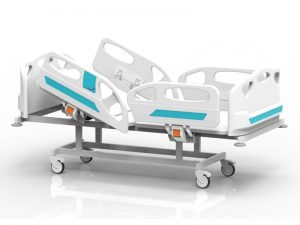
Manual 3-function hospital ward bed (HE-2500) with crank-operated backrest and leg section, gas-spring Trendelenburg, full-length collapsible side rails, detachable head and foot boards, 4-section perforated platform and diagonal-locking 125 mm castors. 180 kg safe working load.
Overview
The 3-Function Ward Bed is a durable hospital bed for general ward care, patient recovery, nursing support and routine clinical treatment. Its adjustable design helps staff position patients comfortably while giving better access for examinations, nursing procedures, transfers and daily care.
It offers three essential positioning functions: backrest and leg-section adjustment by hand crank, and Trendelenburg positioning by gas spring. These support patient comfort, post-operative recovery, mobility assistance and selected clinical positioning.
With full-length collapsible side rails, an electrostatic powder-coated metal frame, a 4-section perforated mattress platform, diagonal-locking castors and drainage-bag hooks on both sides, the bed suits hospitals, clinics, rehabilitation centres, nursing homes and long-term care facilities.
Key Features
Technical Specifications
| Model | HE-2500 |
| Product type | Manual hospital ward bed |
| Functions | 3 |
| Backrest | Manual crank, 0–70° |
| Leg section | Manual crank |
| Knee adjustment | Semi-automatic six-position rack |
| Trendelenburg | Gas-spring assisted |
| Mattress platform | 4-section perforated metal, 87 × 197 cm |
| External dimensions | 205 × 105 cm |
| Height without mattress | 55 cm |
| Side rails | Full-length, collapsible |
| Head / foot boards | Detachable |
| Frame | Metal, electrostatic powder coating |
| Castors | 360° swivel, 125 mm, diagonal locking |
| Drainage-bag hooks | Both sides |
| Safe working load | 180 kg |
| Situation | Guidance |
| General ward care | Adjust the backrest and leg section to the patient’s activity and comfort; keep the bed at a safe height when unattended. |
| Reduced mobility | Use appropriate transfer aids and staff support, and lock the castors before every transfer. |
| Orthopaedic recovery | Follow the treatment plan and avoid movements that increase pain or stress healing structures. |
| Neurological weakness | Assess balance, muscle control, cognition and transfer ability before changing position. |
| Lower-limb swelling | Elevate the leg section only when clinically appropriate; monitor circulation, skin, sensation, swelling and pain. |
Trendelenburg should only be used when prescribed, with patient assessment and supervision. Check drainage tubing regularly to prevent kinking or disconnection.
| HE-2500 | 3-Function Manual Ward Bed |
Clinical Protocols
Recommended starting parameters by indication. Final protocols should be set by the treating clinician.
Related Products
Request a demo, pricing or clinical consultation. Our team responds within one business day.